
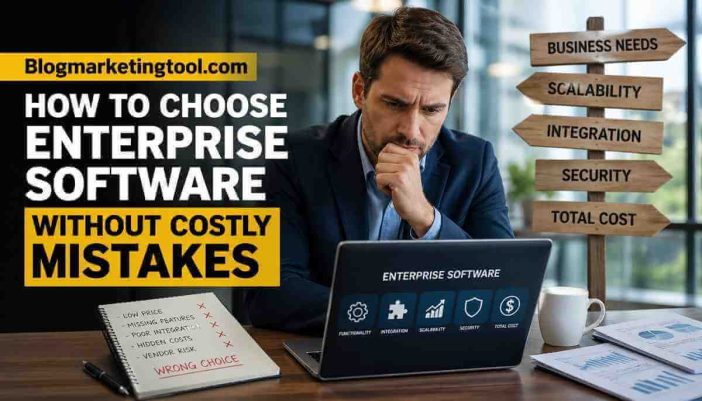
Enterprise software decisions rarely feel uncertain at the beginning.
There’s a shortlist.
There are demos.
There are feature comparisons.
Everything looks aligned.
Then months later:
- Implementation slows
- Costs expand
- Teams adapt around the system instead of using it
The mistake isn’t technical.
It’s structural.
Choosing enterprise software is not about picking the best product.
It’s about making a decision that still works three years later.
How to Choose Enterprise Software (Quick Answer)
To choose enterprise software correctly, evaluate:
- Organizational fit (not features first)
- Total cost of ownership (not price only)
- Vendor dependency and exit risk
- Data ownership and control
- Governance and decision accountability impact
👉 Most failures come from skipping these layers.
The Enterprise Software Selection Framework
1. Start With Organizational Fit (Before Features)
Most companies do the opposite.
They compare:
- Features
- UI
- Integrations
Instead of asking:
- How decisions are made internally
- How rigid workflows should be
- How much change the organization can absorb
This misalignment is a core issue discussed in
Enterprise Software Evaluation Without Vendor Bias, where system failure begins at the evaluation stage.
👉 A perfect system for another company can fail in yours.
2. Analyze Total Cost, Not Just Pricing
Pricing is only the entry point.
A real evaluation must include:
- Subscription cost
- Usage growth
- Integration effort
- Training overhead
- Maintenance burden
This aligns with
Enterprise Software Cost Analysis, where most real cost appears after adoption.
👉 Cheap software can become the most expensive decision.
3. Identify Vendor Lock-In Risk Early
Ask directly:
- Can data be exported easily?
- Are APIs open or restricted?
- What happens if pricing changes?
Vendor dependency often starts subtly.
It becomes critical later.
This risk layer is deeply connected to
Enterprise Systems Risk Architecture, where system design determines long-term flexibility.
👉 If exit is unclear, the decision is incomplete.
4. Evaluate Data Ownership and Control
Enterprise software decisions are ultimately data decisions.
Key questions:
- Who owns the data?
- Where is it stored?
- Who controls access and retention?
This directly relates to governance issues explored in
Understanding Data Governance Beyond Compliance Checklists.
👉 Losing control of data = losing control of decisions.
5. Map Decision Accountability
Before selecting software, define:
- Who approves the system
- Who owns the outcome
- Who absorbs failure risk
This is critical.
Most organizations skip it.
And that leads to:
- Blame diffusion
- Governance confusion
- Delayed decisions
This connects directly to
Decision Accountability In Regulated Enterprises.
👉 No accountability = no real decision.
6. Test Integration Reality (Not Demo Scenarios)
Demos are controlled environments.
Real systems involve:
- Legacy tools
- Data inconsistencies
- Internal constraints
Integration complexity is often underestimated.
This pattern is part of the broader structural breakdown explained in
Accountability Breakdowns in Complex Organizations.
👉 If integration isn’t tested, the evaluation is incomplete.
7. Assess Regulatory and Compliance Impact
Enterprise software affects:
- Data handling
- Reporting obligations
- Audit traceability
Regulatory context shapes system design.
This is explored in
How Regulatory Frameworks Shape Enterprise Decision Environments.
👉 Choosing software without regulatory awareness creates hidden risk.
Decision Checklist
Before final selection, confirm:
- Organizational fit validated
- Total cost projected (3–5 years)
- Vendor lock-in risk assessed
- Data ownership clearly defined
- Accountability assigned
- Integration tested
- Regulatory impact understood
👉 If any of these are unclear, delay the decision.
Common Mistakes When Choosing Enterprise Software
Mistake #1 — Choosing Based on Features
Ignoring structural fit.
Mistake #2 — Trusting Vendor Narrative
Not testing real-world scenarios.
Mistake #3 — Ignoring Exit Strategy
Assuming flexibility later.
Mistake #4 — No Accountability Mapping
Leaving decision ownership unclear.
Expert Insight
From repeated enterprise reviews:
- The biggest failures are predictable
- They happen at the decision stage, not implementation
Organizations that follow structured evaluation:
- Make fewer system changes
- Maintain better cost control
- Avoid long-term lock-in
FAQ
How do you choose enterprise software?
By evaluating organizational fit, cost structure, vendor risk, and governance impact—not just features.
What is the biggest mistake in software selection?
Focusing on product features instead of long-term system impact and decision structure.
How long should evaluation take?
Typically 4–12 weeks, depending on complexity. Rushed decisions increase long-term cost and risk.
Wrapping Up
Choosing enterprise software is not a procurement task.
It is a structural decision that affects:
- Cost
- Control
- Flexibility
- Accountability
👉 Next step:
Apply this framework to your current shortlist.
If the system only looks good in a demo,
it’s not ready for your organization.